
DrHomey exterior design refers to a practical approach to improving a home’s outside appearance and function through coordinated architecture, materials, color, landscaping, lighting, and outdoor spaces. The phrase is associated with DrHomey’s home-design content rather than a formally recognized architectural style, so homeowners should adapt its ideas to their property and climate.
If you are searching for drhomey exterior design, you are likely looking for ideas that connect these jobs rather than treating paint, landscaping, lighting, and the front door as unrelated projects.
One useful clarification comes first. DrHomey exterior design is better understood as a design approach associated with DrHomey’s home-improvement content, not as a formally recognized architectural style. Current DrHomey material discusses exterior design through elements such as architecture, materials, landscaping, lighting, and outdoor living.
That makes the ideas easier to use. You do not need to reproduce a particular “DrHomey look.” Instead, you can apply the underlying principles to your own house.
Table of Contents
- What DrHomey Exterior Design Means
- Start With the Architecture
- Choose Exterior Materials With Purpose
- Build a Coordinated Color Palette
- Treat the Front Entrance as a Focal Point
- Use Landscaping to Connect the House With the Yard
- Plan Exterior Lighting for Function and Atmosphere
- Consider Climate and Energy Performance
- Make Small Improvements Before Major Renovations
- Common Mistakes to Avoid
- FAQs
- Final Thoughts
Key Takeaways
- The phrase refers to a practical home-exterior design approach rather than a recognized architectural style.
- Exterior improvements work better when architecture, materials, color, landscaping, and lighting are planned together.
- Durability and climate should influence material choices just as much as appearance.
- A front entrance can create a strong visual focal point without requiring a complete renovation.
- Small, coordinated changes can sometimes make more sense than replacing everything at once.
What DrHomey Exterior Design Means
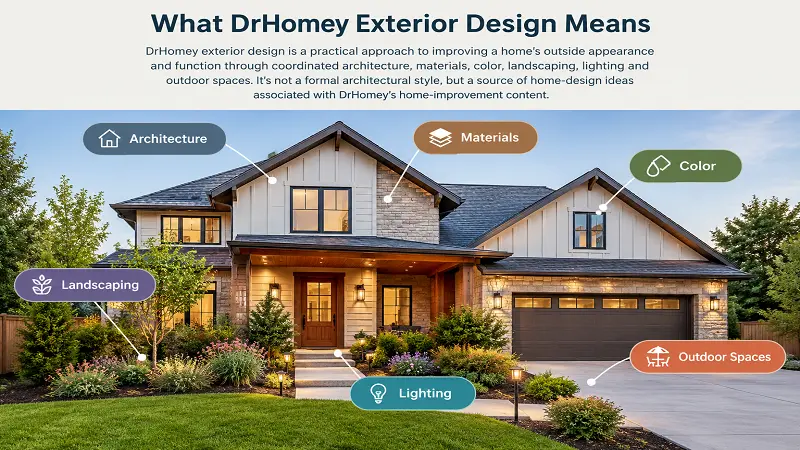
The easiest way to understand the concept is to think beyond decoration.
An attractive exterior should also make sense for the building. The roof, walls, windows, entrance, paths, landscaping, and lighting should feel connected rather than assembled from unrelated choices.
DrHomey’s own exterior-design material emphasizes ideas such as curb appeal, durability, materials, color, lighting, landscaping, and practical outdoor use.
However, there is no authoritative architectural classification establishing “DrHomey exterior design” as a distinct architectural movement.
That distinction matters when researching the term. Treat it as a source of home-design ideas rather than a technical architectural category.
Start With the Architecture
Before choosing a new paint color or buying decorative features, study the house you already have.
Look at the roof shape, window proportions, entrance position, existing brick or siding, and the relationship between the building and the land around it.
A modern façade may work well with simple lines and restrained details. A traditional house may benefit from materials and proportions that respect its existing character.
Work With Fixed Features
Some exterior elements are expensive or difficult to replace.
The roof, driveway, masonry, windows, and major structural features should therefore influence your design decisions.
For example, choosing wall colors without considering an existing roof or brickwork can create a combination that looks disconnected.
A better sequence is:
- Identify the features that will stay.
- Choose the dominant exterior color around them.
- Select secondary materials.
- Add smaller accents afterward.
This prevents inexpensive decorative choices from dictating expensive renovation decisions.
Choose Exterior Materials With Purpose
Exterior materials affect appearance, maintenance, weather resistance, and sometimes energy performance.
Common choices include brick, natural stone, stucco, fiber cement, wood, engineered wood, and vinyl or other manufactured siding.
There is no universally best material. The right choice depends on the home’s architecture, local weather, maintenance expectations, budget, and installation requirements.
Houzz’s 2026 outdoor trends research shows considerable variety in exterior wall materials, with stucco, natural wood, fiber cement, and vinyl among the options homeowners are using.
Think Beyond Appearance
A material that looks excellent in a photograph may not be suitable for every climate.
Consider:
- Moisture exposure
- Direct sunlight
- Temperature changes
- Maintenance requirements
- Local availability
- Repairability
- Installation quality
This is where exterior design becomes more than styling. The material has to work in the environment where it will actually be used.
Build a Coordinated Color Palette
Color can change the character of a home without changing its structure.
A practical palette usually begins with the largest surfaces, followed by trim and smaller accents. This makes it easier to prevent too many competing colors from appearing on one façade.
Current Houzz research found that warm exterior wall colors have become more prominent in its 2026 U.S. outdoor trends data, while contrasting trim is also common.
Architectural Digest’s 2026 coverage similarly highlights exterior paint as a relatively accessible way to refresh a home’s appearance.
Test Color Before Committing
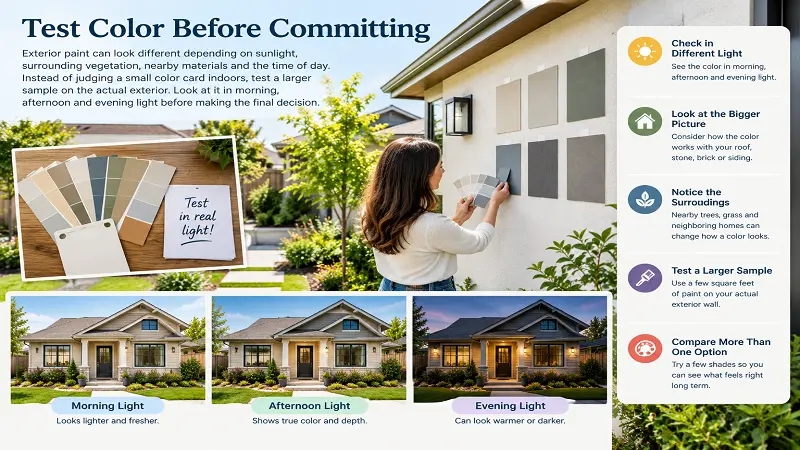
Exterior paint can look different depending on sunlight, surrounding vegetation, nearby materials, and the time of day.
Instead of judging a tiny color card indoors, test a larger sample on the actual exterior.
Look at it in morning, afternoon, and evening light before making the final decision.
Treat the Front Entrance as a Focal Point
The front door is one of the easiest places to give an exterior more personality.
You do not necessarily need an expensive entrance renovation. Proportion and coordination often matter more than adding numerous decorative elements.
Consider:
- A clearly visible path
- Appropriate exterior lighting
- Easy-to-read house numbers
- A door color that relates to the overall palette
- Simple planting around the entrance
- A porch or covered area where the architecture allows it
Architectural Digest’s recent porch guidance also emphasizes the entryway as an important opportunity to improve curb appeal and create a more inviting arrival experience.
Use Landscaping to Connect the House With the Yard
Landscaping should not be treated as something added after the house is finished.
Plants, paths, retaining features, lawn areas, and outdoor seating can help connect the building with its surroundings.
Start by considering how people move around the property.
A pathway should lead somewhere useful. Plants should suit the available sunlight and local conditions. Large trees should be positioned with their eventual size in mind.
Choose Plants for Your Conditions
A plant that looks ideal in a photograph may struggle in another climate.
Think about:
- Sun exposure
- Water availability
- Soil conditions
- Seasonal changes
- Mature plant size
- Maintenance time
Houzz’s 2026 research reports strong homeowner interest in low-maintenance, native, drought-resistant, and pollinator-friendly planting choices.
The broader lesson is simple: choose landscaping for both appearance and survival.
Plan Exterior Lighting for Function and Atmosphere
Outdoor lighting has two jobs.
The first is practical. Paths, steps, entrances, and other areas may need adequate illumination for safe movement.
The second is visual. Carefully positioned lighting can highlight architectural details, plants, walls, or outdoor seating areas.
Houzz’s landscape-lighting guidance notes that pathway, stair, and entry lighting can improve both outdoor usability and the appearance of a property at night.
Avoid illuminating everything equally.
A few purposeful lighting points can create more depth than a large number of bright fixtures.
Consider Climate and Energy Performance
A good-looking exterior can still perform poorly if climate is ignored.
Roofing and windows are particularly important because they are part of the building envelope.
The U.S. Department of Energy explains that cool roofs can reduce heat absorption and may reduce cooling demand in appropriate climates, although the benefit depends on factors such as climate, insulation, roof type, and HVAC efficiency.
Windows also deserve attention. DOE building-science guidance notes that high-performance window systems can improve comfort and reduce energy use, with performance depending on the window system and climate.
This means a drhomey exterior design project should not be judged only from the street.
Ask whether the proposed changes also improve protection, comfort, maintenance, or energy performance.
Make Small Improvements Before Major Renovations
Not every exterior needs a complete makeover.
If the structure is sound, start by identifying the elements creating the biggest visual or functional problem.
A useful order might be:
Clean and repair → improve the entrance → coordinate colors → refine landscaping → improve lighting → consider larger material upgrades.
This approach makes it easier to see what actually needs changing.
For example, replacing a tired light fixture, improving house numbers, trimming overgrown planting, and repainting a front door may produce a noticeable improvement without changing the entire façade.
Common Mistakes to Avoid
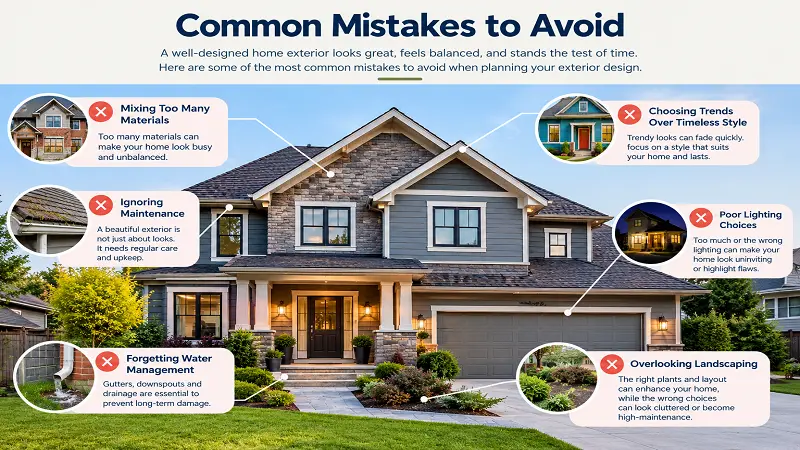
Choosing Trends Before Understanding the House
A design trend should support the architecture, not overpower it.
Mixing Too Many Materials
Brick, stone, wood, metal, and multiple siding styles can become visually confusing when there is no clear relationship between them.
Ignoring Maintenance
A beautiful material that requires more maintenance than you can realistically provide may become a problem later.
Designing Only for Daylight
An exterior can look excellent during the day but lose its character after sunset if entrances, paths, and architectural features have not been considered.
Forgetting Water Management
Gutters, downspouts, drainage, roof condition, and moisture-related problems should be addressed before cosmetic improvements.
Fresh paint cannot solve an underlying water problem.
FAQs
Is DrHomey exterior design a recognized architectural style?
No formal architectural classification was found establishing DrHomey exterior design as a recognized architectural style. The phrase is primarily associated with DrHomey’s home-design content and related online articles. It is more accurate to describe it as a practical design approach or source of exterior ideas.
What are the main elements of DrHomey exterior design?
The main elements include the home’s architecture, exterior materials, colors, entrance, landscaping, lighting, and outdoor living areas. The useful principle is to coordinate these elements instead of designing each one independently.
How can I improve my exterior without a major renovation?
Start with cleaning and repairs, then consider the entrance, paint, lighting, house numbers, planting, and other relatively small features. These changes can improve the overall appearance without requiring a complete exterior remodel.
Should exterior design focus on appearance or function?
Both matter. The exterior protects the building while also shaping its appearance and outdoor usability. Materials, roofing, windows, drainage, lighting, and landscaping should therefore be evaluated for practical performance as well as visual appeal.
How do I choose exterior materials?
Consider the existing architecture, local climate, moisture exposure, maintenance requirements, installation quality, budget, and long-term repair needs. Appearance should be one factor rather than the only factor.
Final Thoughts
DrHomey exterior design is most useful when viewed as a practical way of thinking about the whole exterior rather than as a rigid design style.
Start with the house itself. Work around its architecture, fixed materials, climate, and practical needs. Then coordinate color, landscaping, lighting, and outdoor areas around that foundation.
The strongest exterior is not necessarily the one with the most features. It is the one where the important pieces work together and continue to make sense after the initial makeover is finished.see more